
Blog Details
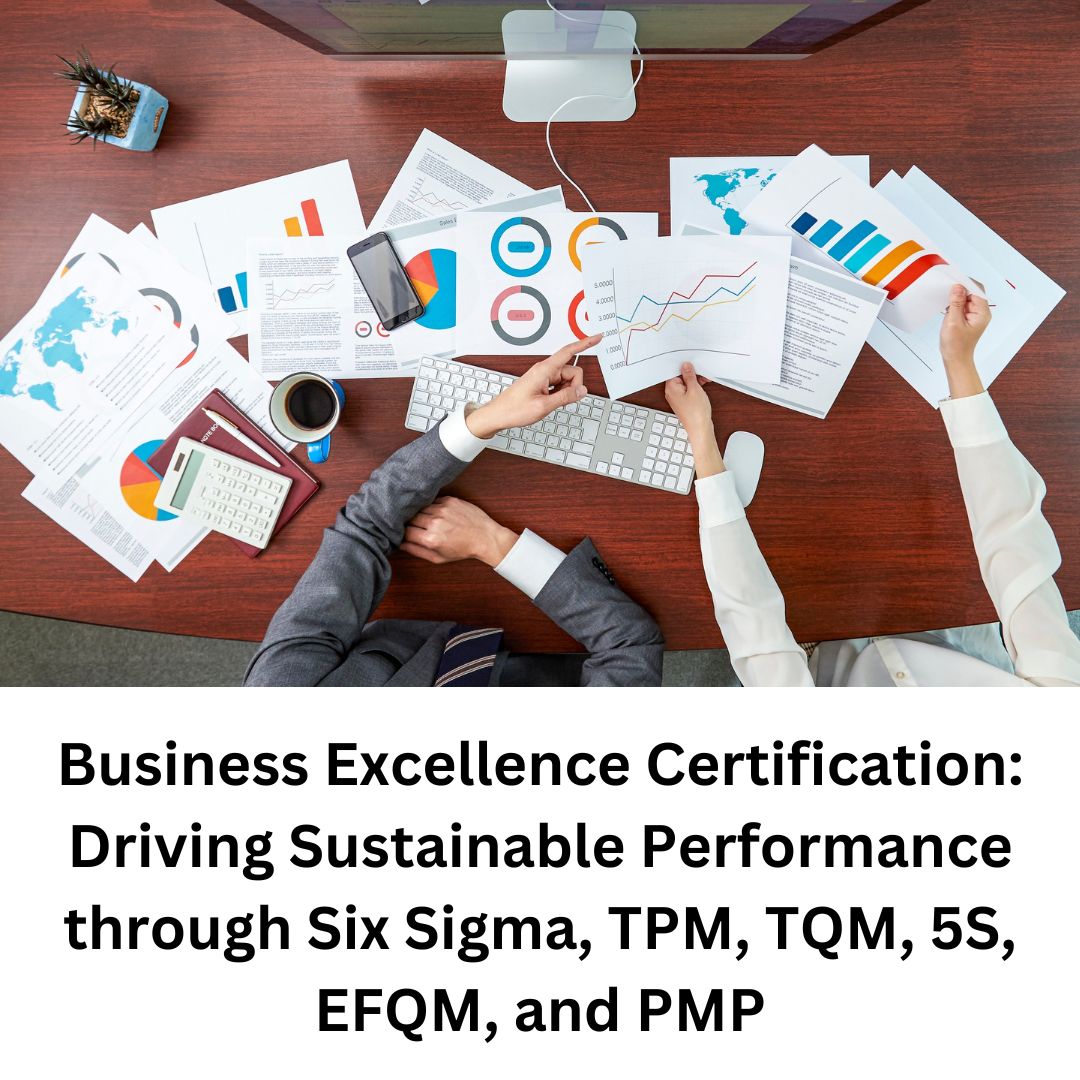
🏆📈 Business Excellence Certification: Driving Sustainable Performance through Proven Frameworks
🚀 In today’s highly competitive and fast-evolving business environment, organizations must go beyond basic compliance and focus on continuous improvement, operational efficiency, and strategic excellence. Business Excellence Certifications provide structured frameworks and globally recognized methodologies that help organizations improve quality, reduce waste, enhance productivity, and achieve sustainable growth.
🌍 Among the most widely adopted business excellence approaches are Six Sigma, Total Productive Maintenance (TPM), Total Quality Management (TQM), 5S, EFQM Excellence Model, and Project Management Professional (PMP). Each plays a unique yet complementary role in building world-class organizations.
⚙️ Understanding Business Excellence Certification
🧩 Business excellence certification refers to formal recognition that an organization or professional has adopted proven management practices, performance improvement tools, and quality frameworks. These certifications help align people, processes, and technology with strategic objectives while ensuring customer satisfaction and continuous improvement.
🔄 Unlike function-specific standards, business excellence frameworks promote a holistic, organization-wide approach to performance improvement.
📊 Six Sigma: Eliminating Defects and Improving Quality
📉 Six Sigma is a data-driven methodology focused on reducing defects, minimizing process variation, and improving overall quality. Using structured problem-solving techniques such as DMAIC (Define, Measure, Analyze, Improve, Control), organizations can identify root causes of inefficiencies and implement sustainable solutions.
🏭 Widely used across manufacturing, IT, healthcare, finance, and service industries, Six Sigma delivers measurable benefits including reduced costs, improved customer satisfaction, and data-based decision-making.
🛠️ TPM: Maximizing Equipment Efficiency
⚙️ Total Productive Maintenance (TPM) focuses on maximizing equipment effectiveness by involving all employees—from operators to top management. The goal is to achieve zero breakdowns, zero defects, and zero accidents.
🔧 TPM certification helps reduce downtime, increase productivity, and extend asset life while promoting proactive maintenance and employee ownership of equipment.
🎯 TQM: Building a Culture of Quality
🤝 Total Quality Management (TQM) is a comprehensive management philosophy emphasizing customer satisfaction, employee involvement, and continuous improvement across all processes.
📘 TQM certification integrates quality into organizational culture and leadership, enabling consistent delivery of high-quality products and services while adapting to changing market demands.
🧹 5S: Creating an Organized and Efficient Workplace
🗂️ The 5S methodology—Sort, Set in Order, Shine, Standardize, and Sustain—is a foundational tool for workplace organization and efficiency.
👷 5S certification reduces waste, improves safety, boosts productivity, and enhances employee morale. It often serves as the foundation for Lean, Six Sigma, and TPM initiatives.
🌐 EFQM Excellence Model: A Holistic Performance Framework
🏛️ The EFQM Excellence Model is a globally recognized framework designed to help organizations assess and improve overall performance. It focuses on leadership, strategy, people, partnerships, processes, and results.
📈 EFQM certification supports benchmarking, innovation, agility, and resilience, making it suitable for organizations of all sizes and sectors.
📅 PMP: Excellence in Project Management
📌 The Project Management Professional (PMP) certification, awarded by PMI, is a globally respected credential for project managers. It emphasizes best practices in planning, execution, monitoring, and delivery.
🧠 Organizations with PMP-certified professionals achieve higher project success rates, improved risk management, and efficient resource utilization.
🔗 Integrating Business Excellence Certifications
🔄 While each certification delivers distinct benefits, their true strength lies in integration. 5S and TPM strengthen operational foundations, Six Sigma and TQM enhance quality and process control, EFQM aligns strategy with performance, and PMP ensures effective execution.
🏁 Conclusion
🌟 Business excellence certification is no longer a luxury—it is a strategic necessity. By adopting frameworks such as Six Sigma, TPM, TQM, 5S, EFQM, and PMP, organizations can build a culture of excellence, achieve measurable improvements, and ensure long-term success in the global marketplace.
Leave a Comment
We would love to hear your thoughts! Please leave your comment below: